

Smart web design
Smart web design fulfills your vision for your website and makes it possible to accomplish your business goals. It is a balance of brand extension, user interface, and information architecture. Perfect web design should not hit you over the head — it should whisper in your ear. It must simultaneously reinforce your brand and get out of the way to let the user experience convey your message.
At Bear Creek Web, we work with you to create a website design that communicates your value to the people who visit your site, whether it’s on desktop, mobile or a combination of both. Understanding how user experience directs effective design choices is only one of our areas of expertise.
We are committed to creating websites for our clients that not only look incredible and perform well, but that also directly guide and direct user interactions to obtain the desired effect – more engagement, more conversions, more leads and more sales.
We’ve come up with a simple step-by-step method for distilling your value proposition, understanding your buyer personas and crafting a website designed to specifically appeal to the people in your target audience.
When you contact us to schedule a design review, you can rest assured that your website will be crafted with the utmost attention to detail and with ongoing support and updates that you can rely on for incredible results.
Take a look at our web design portfolio to view our work, or read on to find out how we put together the different pieces of the web design puzzle to create a perfect design that gets results every time.
 Mobile web design
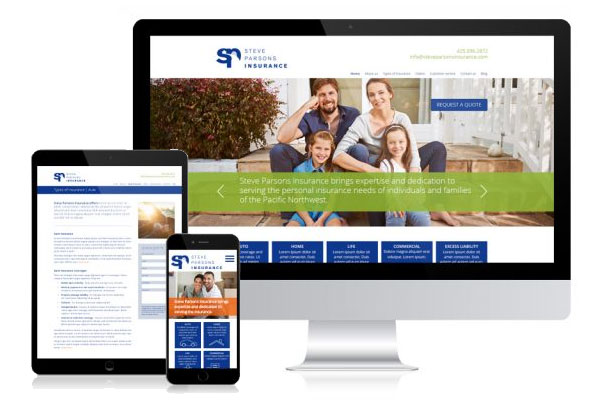
Proper mobile optimization is more important now than ever before with Google’s latest initiative to directly correlate mobile optimization to organic search engine rank.
Taking it a step further, you can be sure that the mobile experience your users have will directly impact whether or not they choose to do business with your company.
Many consumers now take a “two screen” approach to finding what they need online where initial research is conducted on a phone or tablet, and subsequent website visits occur on the desktop.
What this means for you is that in six seconds or less, your mobile website experience can deliver a powerful reason to keep browsing, or send potential customers looking elsewhere.
The most engaging mobile websites provide nearly seamless functionality between the mobile experience and the desktop experience, with buttons, forms and other elements readily optimized for multiple screen sizes so that website visitors can accomplish what they set out to do regardless of the device they use to access the website.
For a more in-depth explanation of responsive design, take a look at our blog post on the topic. And if you’re curious about the difference responsive web design can make when it comes to results for your website, you can read more here.
As part of our comprehensive mobile web design package, we make sure your website loads quickly across a variety of mobile browsers including the latest versions of Chrome, Firefox, Opera and Safari.
Our adherence to platform agnostic responsive design means your website looks perfect whether it’s displayed on a 3-inch phone screen, a 10-inch tablet screen or any size in between.
If you are happy with your current website design but it is not optimized for mobile users, we can re-create your current website design using a responsive framework that will allow it to adjust to multiple screen sizes without sacrificing the look on the desktop.
If your current website isn’t performing as well as you’d like, we can create an all-new website design for your business that looks beautiful and functions perfectly on a wide range of devices, both desktop and mobile.
Our rigorous mobile testing and development ensures that your website meets all of the criteria for an excellent mobile browsing experience including:
- Fast load times
- Appropriately-sized button and tap targets
- Accurate user-agent detection
- Legible and appropriately-sized fonts
- Responsive design that adapts to screen sizes and rotation
 Website development
While web design encompasses the work required to perfect the look of your website, web development handles all of the back-end programming that makes your website work.
The coding required for essential website functionality, including CSS, JavaScript, jQuery, and HTML all fall under the web development category as does database creation and maintenance.
To be effective, a compelling design must be coupled with valid, standards-based markup language. Advantages of the current standards include:
- Your website will open and load much faster due to reduced file size
- Your website will look good across all platforms (Mac, PC, etc.) and all browsers (Internet Explorer, Firefox, etc.)
- Your website will be easier to maintain (because predictable things happen when we modify code vs. unpredictable), resulting in reduced costs
- Your website can evolve as standards evolve; it won’t become obsolete due to the use of proprietary code
- Your website will incorporate accessibility so that the millions of people affected by disabilities will be able to view and use your content
- Your website will be viewable and usable by all the different user-agents of the Web (browsers, cell phones, PDAs, screen readers for the blind, and search bots like Google)
- Your website will communicate in a way that is understood by everyone, regardless of what they are using to access the Internet
Sadly, the majority of sites you see today are not standards-compliant. There are a number of reasons this occurs, but the primary reason is a lack of knowledge and skill. As a client of Bear Creek Web, you won’t have that problem.
What is standards-based markup?
This is a phrase that has many different interpretations. For some developers, Web standards-compliant simply refers to a “table-free site.” For others, it may mean that the code has been “validated.”
Our interpretation, which is a bit stricter than most, means:
- The Web site adheres to proper and currently accepted Web standards such as HTML, XHTML, XML, CSS, XSLT, DOM, etc.
- The Web site adheres to best practices for valid code, semantically correct code, user-friendly URLs, proper 404 error pages, etc.
- The Web site presentation, structure and content are properly separated. We accomplish this by placing the presentation in a Cascading Style Sheet (CSS), the structure in a template, and the content in the page itself or in a database.
Who decides what the standards are?
The World Wide Web Consortium (W3C) is one of the most influential organizations for setting Web standards. They release technical specifications, recommendations and other documents guiding proper implementation. But in order for their standards to work, Web authors and browser companies must both read, understand and implement them.
We at Bear Creek Web read, understand and implement. You’ll never have to worry about a site we’ve created becoming obsolesced by new standards.
When you’ve finalized your design concepts with us and everything is “perfect” our developers step in to begin the work of transforming the vision of your website into a reality.
Our team of professionals handles all of the critical technical aspects for you, ensuring that your website runs at its best and performs the way you expect.
By creating rock-solid code that is robust and scalable, our developers make certain that your website will perform at its best and can grow as you grow. And because we have extensive experience in seamlessly tying together design and performance, you can rely on us to accurately reproduce your website across multiple browsers, screen sizes and devices without sacrificing speed, reliability and security.
As a part of the initial web development process, we will discuss the available technologies with you and guide you in determining what kind of functionality is best-suited for your business website.
 Content management
Far from the static “online brochures” of decades’ past, most of today’s business websites are ever-evolving, constantly updated and personalized to reflect the needs of specific customer personas.
With the increased content production demands of SEO and content marketing, companies need a simple way to update their websites without breaking the underlying code that handles display and presentation of content.
A robust content management system (CMS) fulfills this role by allowing anyone to update and edit content on pages and blog posts through a simple web interface.
Using an intuitive WYSIWYG (what-you-see-is-what-you-get) editor, you can change the layout of your web pages much as you would use format options in Microsoft Word. In addition, a properly customized CMS will allow you to easily add photo galleries, calendars of events, and news/blog entries.
There are many types of content management systems available, and choosing the right one can mean the difference between quickly updating your site and waiting around for days or weeks for someone more technically skilled to make the changes for you.
In 2002, we built our own content management system from the ground up to address the needs of our customers before more mainstream options were available.
Since then, we’ve worked with and modified many different types of content management systems to improve speed, reliability and security for our clients’ websites.
With so much hands-on experience in creating and modifying CMS setups, you can rely on Bear Creek Web to make sure that you get exactly the right CMS for your business.
Unlike our competition, which generally relies on a few standard CMS options set up in a cookie-cutter fashion, we ensure that you have exactly the right functionality and features to make updating your site’s content as easy as possible.. For those who need a little extra help, we can also provide assistance and guidance as you learn about your new CMS so that you can directly edit your content without any knowledge of programming languages or coding practices.
For more information about various CMS options, you can check out our blog post on Umbraco vs. WordPress, or contact us – we’ll be happy to answer your questions.
 Content development
Writing website content is not like writing a book. Your customers rarely curl up by the fire with a good website and a cup of coffee. They want information that is concise, relevant, easy to find and well written. If a subject is complex and wordy, give your customers an overview, plus the option to dig deeper. A great way to add well-written content to your website is with a blog. Check our out blog for tips for better business blogging.
Here are a few authoring tips:
Keep it short
Visitors come to your website for a purpose and are typically very goal-oriented. Your copy should be designed for the impatient reader. Here are some guidelines:
- Headings: 8 words or less
- Sentences: 15 – 20 words
- Paragraphs: 40 – 70 words
Scanners
Visitors to your website will not read each and every word. Rather, they will scan at high speed looking for the key words they find important. They’ll scan headings first, links second, and then the body text in the middle of the page. Because of this pattern, headings and links are the most important pieces of content. Headings must concisely describe what follows, and links must contain enough words to let users know where they are going.
Write for how people search
If you want your site to be found when people search the web, use the words and phrases your customers are looking for. Before you begin, write down these keywords and then carefully weave them into your copy.
Sell benefits, not features
If you want your website to sell your product or service successfully, write about benefits more than about features. A feature’s only relevance is that it solves a need. Your customers don’t care that their new cell phone has an “omni-directional amplified antenna.” They care that they will “never again drop an important phone call.”
Edit. Edit. Edit.
Have two or three people proofread your text. Check it for consistency in grammar, punctuation, capitalization, abbreviations, etc. Mercilessly prune out unneeded words.
We can help
If you are uncomfortable or inexperienced writing for the web, you may wish to utilize our copy services. This is an item we will discuss during our discovery meeting.
 E-Commerce solutions
Our extensive experience with Web commerce allows us to develop custom solutions designed specifically to deliver results for you. In some cases, an off-the-shelf package may meet your needs and provide significant savings.
During our initial consultation, we will help guide you to the best choice for your business. All of our e-commerce solutions have extremely powerful merchant administration areas that allow you to:
- Add and delete products
- Manage product categories
- Create product sales
- Create quantity discounts
- Process and track orders, payments and credits
- Provide online order history for shoppers and administrators
- Create and mail to e-mail lists
- Create sales reports
- Utilize integrated real-time shipping rates (UPS)
- Utilize integrated tracking (UPS)
 Information architecture
Web design supports your website’s goals by providing the look and feel that supports your brand and by helping to convey your value proposition to your target audience visually.
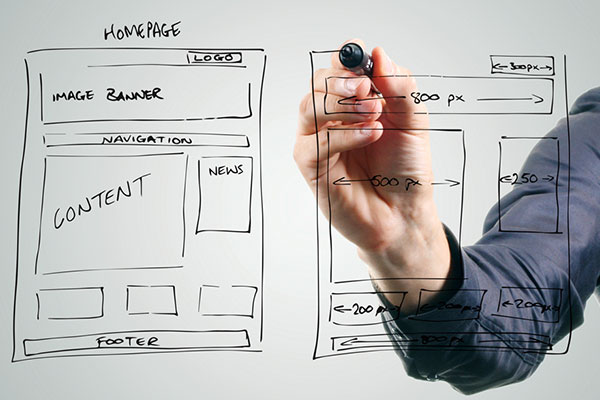
Information architecture (IA) supports your website’s goals by organizing and structuring your website in a way that it makes it fast and simple for your website’s visitors to find everything they need on your site.
IA functions through control and organization, starting with the site map established for your website and moving forward with wireframes for content organization including menus, callouts and other items.
In the simplest terms, IA is the framework your website is built around.
This functional outline controls what information is shown on your site, when that information is shown, and how pages are linked together internally.
Taking it a step further, IA also helps to identify the most logical navigation paths for users and how to help them find what they need with the minimal amount of effort. Linking techniques such as using “breadcrumbs” to help users navigate through deeper portions of your website are also a part of information architecture.
Bear Creek Web has a variety of tools and tips to help us harness IA to achieve the results you expect from your website. To learn more, please see our blog on optimizing the user experience.
And check out our blog post for specific steps on how to create a sitemap for your website that facilitates usability and ease of navigation
 Webmastering
Keeping your website up to date is critical to attract and retain customers. As Google puts more emphasis on having “fresh” content, website owners are faced with the challenge of continually updating their site to reflect new information and insights their target audiences will find useful.
While a CMS can make it easy to implement these changes, sometimes updates can be extensive or complex. It may also be the case that key personnel are not available to make a needed change in the timeframe that is necessary to accomplish your goals.
In these instances Bear Creek Web quickly implements requested updates and effectively handles the day-to-day operation of your website including content and multimedia updates.
We can process most changes within 24 hours (in truth, most changes are made within an hour or two), and if for any reason a change needs to be made more quickly than that, we’ll do everything in our power to make it happen for you.